- United Kingdom
- Acanthodes (Acanthodi, Lo.-Up. Carb., Scotland, England)
- Adelospondylus (Lepospond.,Lo. carb. [Serp.], Scotland)
- Anthracosaurus (Embolomeri, Up. Carb. [Westph B, Moscov.], Scotland)
- Asylosaurus (Sauropod Triassic, Bristol)
- Baryonyx (Theropod, Wealden beds, Lo. Cret. [Barrem.], England)
- Camelotia (Sauropod., Westbury Fm, Up. Trias. [Rhaetian], England)
- Climatius (Acanthodi, Lo. Dev., Scotland)
- Coccosteus (Placodermi, Mid Dev, [Eifelian-Givetian], Scotland)
- Dakosaurus (Thalattosuchia, Upper Jurassic. [Kimm/Tithon] England)
- Dimorphodon (Pterosaur, Lyme Regis, Lo. Jur. [Sinem.], England)
- Elginia (Pareiasaur, Elgin Fm, Up. Perm. [Wuch.])
- Eustreptospondylus (Theropod, Oxford Clay Fm, Mi. Jur. [Call.], England)
- Gnathosaurus (Pterosaur, Wealden, Up. Jur. [Tith.], England)
- Ischnacanthus (Acanthodii, Old Red Sandstone Fm, Lo Dev, Scotland)
- Istiodactylus (Pterosaur, Vectis Fm, Lo. Cret. [Barr.] Isle of Wight)
- Lonchodectes (Pterosauria, Lower - Upper Cretaceous, England)
- Metriorhynchus (Thalattosuchia, Low to Upper Jurassic, England, Europe)
- Ornithocheirus (Pterosauria, Upper Cretaceous [Ceno], England, Europe)
- Palaeoherpeton
- Pantydraco (Sauropod., Up. Trias. [Rhaet.] or Lo. Jur. [Hett.] South Wales)
- Parexus
- Pederpes
- Pelagosaurus (Thalattosuchia, Lower Jurassic. [Toar] Somerset)
- Pholiderpeton
- Proterogyrinus
- Steneosaurus (Thalattosuchia, Low Jurassic/Low Cret. England)
- Thecodontosaurus (Sauropod., Bristol, Up. Trias. [Nor.-Rhaet.] England)
- Scat Craigs Beds, Scotland, Upper Devonian (Upper Frasnian)
- Cosmacanthus malcolmsoni (Placodermi Arthrodira Groenlendaspididae)
- Bothriolepis paradoxa (Placodermi Antiarchi)
- Psammosteus cf falcatus (Heterostraci Psammostiform Psammosteidae)
- Traquairosteus pustulatus (Heterostraci Psammostiform Psammosteidae)
- Holoptychius nobilissimus (Sarcopterygii Porolepiform)
- Holoptychius giganteus (Sarcopterygii Porolepiform)
- Holoptychius decoratus (Sarcopterygii Porolepiform)
- Duffichthys mirabilis (Sarcopterygii Porolepiform)
- Conchodus ostreiformis (Dipnoi Dipteridae)
- Elginerpeton pancheni (Tetrapoda Elginerpetontidae)
- Scotland, Lower Carboniferous (Visean-Namurian)
- Chondrenchelys problematica (Chondrichthyes Chondrenchelyiform) Glencartholm
- Crassigyrinus scoticus (Tetrapoda Crassigyrinidae) Gilmerton
- Acherontiscus caledoniae (Lepospondyli Adelospondyli Acherontiscidae)
- Adelogyrinus simnorhynchus (Lepospondyli Adelospondyli Adelogyrinidae) Dunnet Shale
- Palaeomolgophis scoticus (Lepospondyli Adelospondyli Adelogyrinidae) Curley Shale
- Lethiscus stocki (Lepospondyli Aistopoda Lethiscidae)
- Ophiderpeton kirktonense (Lepospondyli Aistopoda Ophiderpetontidae) East Kikton
- Silvanerpeton miripides (Embolomeri) East Kirkton
- Eoherpeton watsoni (Embolomeri Eoherpetontidae) Gilmerton
- Pholidogaster pisciformis (Colosteoidea Colosteidae) Gilmerton
- Casineria kiddi (Amniota) Gullane Fm
- Newsham, Northumberland, UK, Upper Carboniferous (Westphalian B, Lower Moscovian)
- Pteroplax cornutus (Embolomeri Eogyrinidae)
- Eogyrinus attheyi (Embolomeri Eogyrinidae)
- Anthracosaurus russelli (Embolomeri Anthracosauria Anthracosauridae)
- ?Ophiderpeton nanum (lepospondyli Aistopoda Ophiderpetontidae)
- Batrachiderpeton reticulatum (Lepospondyli Nectridea Keraterpetontidae)
- Megalocephalus pachycephalus (Temnospondyli Loxommatidae)
- Kenilworth Sandstone Formation, England, Lower Permian (Asselian)
- Haptodus grandis (Synapsida Eupelycosauria Sphenacodontia Haptodidae)
- Lossiemouth Sanstones Formation, Scotland, Upper Triassic (Latest Carnian/Early Norian)
- Leptopleuron lacertinum (Anapsida Procolophonomorpha Procolophonidae)
- Brachyrhinodon taylori (Sphenodontia Sphenodontidae)
- Hyperodapedon gordoni (Rhynchosauria Rhynchosauridae)
- Ornithosuchus longidens (Ornithosuchia Ornithosuchidae)
- Stagonolepis robersoni (Aetosauria Stagonolepidae)
- Erpetosuchus granti (Paracrocodylomorpha Erpetosuchidae)
- Saltopus elginensis (Archosauria)
- Scleromochlus taylori (Archosauria Scleromochlidae)
- England, Upper Triassic (Norian-Rhaetian)
- Diphydontosaurus avonis (Sphenodontia Sphenodontidae)
- Rileyasuchus bristolensis (Phytosauria) nomen dubium
- Agnosphytis cromhallensis (Saurischia?)
- Asylosaurus yalensis (Sauropodomorpha)
- Thecodontosaurus antiquus (Sauropodomorpha)
- Wales, Upper Triassic (Norian/Rhaetian)
- Terrestrisuchus gracilis (Crocodylomorpha Sphenosuchis Sphenosuchidae)
- SouthWest England, Upper Triassic (Rhaetian)
- Pachystropheus rhaeticus (Choristodera)
- Lias Formation, England, Lower Jurassic (Early Sinemurian)
- Sarcosaurus woodi (Theropoda Coelophysoidea?)
- Charmouth Mudstone Formation, Dorset, England, Lower Jurassic (Sinemurian)
- Scelidosaurus harrisonii (Ornithischia Ankylosauria Scelidosauridae)
- Ichthyosaurus (Ichthyopterygia IchthyosauriaThunnosauria)
- Middle Inferior Oolite Formation, Inferior Oolite Group, England, Middle Jurassic (Lower Bajocian)
- Magnosaurus nethercombensis (Theropoda Megalosauroidea Megalosauridae)
- Oxford Clay Formation, South England, Middle-Upper Jurassic (Callovian-Lower Oxfordian)
- Gryphaea dilatata (Mollusca Bivalvia Gryphaeidae) Weymouth member, Oxfordian
- Loricatosaurus priscus (Ornithischia Stegosauria Stegosauridae Stegosaurinae)
- Lexovisaurus durobrivensis (Ornithischia Stegosauria Stegosauridae Stegosaurinae)
- Callovosaurus leedsi (Ornithopoda Iguanodontia Dryosauridae)
- Cetiosauriscus stewarti (Sauropoda Diplodocoidea Diplodocidae)
- Metriacanthosaurus parkeri (Theropoda Carnosauria Sinraptoridae) Weymouth member, Oxfordian
- Taynton Limestone Formation, England, Middle Jurassic (Middle Bathonian)
- Megalosaurus bucklandii (Theropoda Megalosauroidea Megalosauridae)
- Iliosuchus incognitus (Theropoda Coelurosauria Tyrannosauroidea?)
- Kilmaluag Formation, Skye, Scotland, Middle Jurassic (Late Bathonian)
- Marmorerpeton kermacki (Lissamphibia)
- Kirlington, Oxfordshire, England, Middle Jurassic (Late Bathonian)
- Anoualerpeton priscus (Lissamphibia Allocaudata Albanerpetontidae)
- Marmorerpeton kermacki (Lissamphibia Caudata)
- Marmorerpeton freemani (Lissamphibia Caudata)
- Eodiscoglossus oxoniensis (Lissamphibia Salientia Discoglossoidea)
- Ctenogenys sp. (Choristodera)
- Chipping Norton Limestone Formation, Great Oolite Group, England, Middle Jurassic (Lower Bathonian)
- Cruxicheiros newmanorum (Theropoda Tetanurae?)
- Forest Marble Formation, Great Oolite Group, Wiltshire, England, Middle Jurassic (Bathonian)
- Cardiodon rugulosus (Sauropoda)
- Cetiosaurus oxoniensis (Sauropoda Cetiosauridae)
- Bothriospondylus robustus (Sauropoda Macronaria Brachiosauridae?) nomen dubium
- White Limestone Formation, Great Oolite Group, Gloucestershire, England, Middle Jurassic (Middle to Late Bathonian)
- Proceratosaurus bradleyi (Theropoda Tyrannosauroidea)
- Kimmeridge Clay Formation, South England, Upper Jurassic (Kimmeridgian-Tithonian)
- Dacentrurus armatus (Ornithischia Stegosauria Stegosauridae Dacentrurinae)
- Camptosaurus prestwichii (Ornithopoda Iguanodontia Camptosauridae)
- Bothriospondylus suffosus (Sauropoda Macronaria Brachiosauridae?) nomen dubium
- Nannopterygius enthekiodon (Ichthyopterygia Ichthyosauria Thunnosauria Ophthalmosauridae)
- Brachypterygius extremus, B. mordax (Ichthyopterygia Ichthyosauria Thunnosauria)
- Stokesosaurus langhami (Theropoda Tyrannosauroidea)
- Lulworth Formation, England, UK, Lower Cretaceous (Berriasian)
- Nuthetes destructor (Theropoda Deinonychosauria Dromaeosauridae)
- Hasting Beds, Sussex, Lower Cretaceous (Berriasian-Valanginian)
- Regnosaurus northamptoni (Ornithischia Stegosauria)
- Ashdown Formation, Hastings Group, Sussex, England, Lower Cretaceous (Early Valanginian)
- Xenoposeidon proneneukos (Sauropoda Neosauropoda)
- Speeton Clay Formation, Germany & England, Lower Cretaceous (basal Hauterivian)
- Acamptonectes densus (Ichthyopterygia Ichthyosauria Opthalmosauridae Opthalmosaurinae)
- Tunbridge Wells Sand Formation, Hastings Group, England, Lower Cretaceous (Upper Valanginian - Lower Hauterivian)
- Valdoraptor oweni (Theropoda Tetanurae)
- Wealden Group, England, UK, Lower Cretaceous (Hauterivian.-Aptian)
- Pelorosaurus conybeari (Sauropoda Macronaria Brachiosauridae?)
- Iuticosaurus valdensis (Sauropoda Macronaria Titanosauria)
- Becklespinax altispinus (Theropoda Carnosauria Allosauroidea)
- Wessex Formation, Wealden Group, Isle of Wight, UK, Lower Cretaceous (Upper Hauterivian- Lower Barremian)
- Polyacrodus parvidens (Elasmobranchii Polyacrodontidae)
- Lissodus striatus (Elasmobranchii Lonchidiidae)
- Lissodus breve (Elasmobranchii Lonchidiidae)
- Caulkicephalus trimicrodon (Pterosauria Pterodactyloidea Ornithocheirididae)
- Hypsilophodon foxii (Ornithopoda Hypsilophodontidae)
- Iguanodon bernissartensis (Ornithopoda Iguanodontia Iguanodontidae)
- Mantellisaurus atherfieldensis (Ornithopoda Iguanodontia)
- Valdosaurus canaliculatus (Ornithopoda Iguanodontia Dryosauridae)
- Mantellisaurus atherfieldensis (Ornithopoda Iguanodontia Iguanodontoidea)
- Oplosaurus armatus (Sauropoda Turiasauria?)
- Eucamerotus foxi (Sauropoda Macronaria Brachiosauridae?) nomen dubium
- Yaverlandia bitholus (Theropoda Tetanurae)
- Neovenator salerii (Theropoda Carnosauria Neovenatoridae)
- Calamosaurus foxi (Theropoda Coelurosauria?)
- Aristosuchus pusillus (Theropoda Compsognathidae)
- Thecocoelurus daviesi (Theropoda Therizinosauroidea?)
- Eotyrannus lengi (Theropoda Tyrannosauroidea)
- Vectis Formation, Wealden Group, Isle of Wight, UK, Lower Cretaceous (Barremian-Aptian)
- Mantellisaurus atherfieldensis (Ornithopoda Iguanodontia Iguanodontoidea)
- Cambridge Greensand Formation, Lower-Upper Cretaceous (Albian-Cenomanian)
- Ornithocheirus simus (Pterosauria Pterodactyloidea Ornithocheirididae)
- Ornithocheirus denticulatus (Pterosauria Pterodactyloidea Ornithocheirididae)
- Anhanguera fittoni (Pterosauria Pterodactyloidea Ornithocheirididae)
- Coloborhynchus sedgwicki (Pterosauria Pterodactyloidea Ornithocheirididae)
- Lonchodectes machaeorhynchus (Pterosauria Pterodactyloidea Lonchodectidae)
- Lonchodectes microdon (Pterosauria Pterodactyloidea Lonchodectidae)
- Anoplosaurus curtonotus (Ornithischia Ankylosauria Nodosauridae)
- Brachypterygius cantabridgiensis (Ichthyopterygia Ichthyosauria Thunnosauria)
Saturday, 14 December 2013
United Kingdom

Tuesday, 10 December 2013
Ichthyosaurus
Ichthyosaurus was the first ichthyosaur named and thus gave rise to the family name Ichthyosauridae. Ichthyosaurus like most ichthyosaurs is often misidentified as a 'swimming dinosaur', although ichthyosaurs were not dinosaurs they were marine reptiles, though superficially they resemble dolphins and sharks. Ichthyosaurus is one of the most commonly known marine reptiles in the U.K. (though tentative material has been assigned to the genus outside of the UK) especially I. communis, the most common of the Ichthyosaurus species. I. intermedius is a dubious species and currently a nomen dubium, it is largely based on a difference in tooth morphology, which has been disputed.
Fossilised gastric contents (stomach material) have even been discovered with ichthyosaur specimens, here the remnants of an ichthyosaur's last meal before it died can be found. The most common remains include tiny ‘hooks’; that belonged to squid (on their tentacles) and fish scales. However, fragments of bone and isolated teeth have also been discovered in ichthyosaur coprolites.
Fossilised gastric contents (stomach material) have even been discovered with ichthyosaur specimens, here the remnants of an ichthyosaur's last meal before it died can be found. The most common remains include tiny ‘hooks’; that belonged to squid (on their tentacles) and fish scales. However, fragments of bone and isolated teeth have also been discovered in ichthyosaur coprolites.
- I
- Name
- Ichthyosaurus communis
- Authority
- Conybeare, 1822
- Meaning of generic name
- "Fish Lizard"
- Meaning of specific name
- The most common species of Ichthyosaurus
- Size
- Length: 8.2 ft (2.5 m) perhaps largest 3-5 m
- Remains
- Holotype lost Neotype: BMNH R1162 Almost complete skeleton at the BMNH London. Numerous complete and partial skeletons.
- Age and Distribution
- Horizon: (1)Schlotheimia angulata to Arnioceras semicostatum zones Blue Lias Formation Early Jurassic (Upper Hettangian - Lower Sinemurian) (2)Psiloceras planorbis zone Uppermost Triassic (Rhaetian) and Early Jurassic (Lower Hettangian) (3)Early Jurassic (Upper Sinemurian) (4) Beggingen Member Semicostatum zone Early Jurassic (Lower Sinemurian)
Locality: (1)Lyme Regis, Dorset (2)Street, Somerset (3)Belgian Lorraine (Belgium) (4)Canton Aargau Switzerland - Classification
- Ichthyopterygia IchthyosauriaThunnosauria
- Further Reading
- McGowan, C. 1974. A revision of the Latipinnate ichthyosaurs of the Lower Jurassic of England. Life Sciences Contribution 100, Royal Ontario Museum, 30 pp.
Lomax, D. R. 2010. An Ichthyosaurus (Reptilia, Ichthyosauria) with gastric contents from Charmouth, England: First report of the genus from the Pliensbachian. Paludicola 8(1):22-36 September 2010 © by the Rochester Institute of Vertebrate Paleontology
Lydekker, R. 1889. Catalogue of the fossil Reptilia and Amphibia in the British Museum (Natural History), Cromwell Road, S.W. Part II. Containing the Orders Ichthyopterygia and Sauropterygia. British Museum, Natural History), London.
Godefroit, P. 1995. Un crane d’ichthyosaurus communis (Reptilia, Ichthyosauria) du Sinemurian superieru de Lorrain Belge. Bulletin de la Société belge de Géologie 104:77-89.
Maisch, M. W., A. G. Reisdorf, R. Schlatter, and A. Wetzel 2008. A large skull of Ichthyosaurus (Reptilia, Ichthyosauria) from the Lower Sinemurian (Lower Jurassic) of Frick (NW Switzerland). Swiss Journal of Geoscience 101: 617-627. - Synonyms
- Ichthyosaurus chiropolyostius, Hawkins 1834
- Images by Nobu Tamura (click to enlarge)
Ichthyosaurus communis [March 1, 2009]: 
[January 11, 2010]: 
- II
- Name
- Ichthyosaurus 'intermedius'
- Authority
- Conybeare, 1822
- Meaning of specific name
- intermediary
- Size
- Skull length: Less than 40 cm Length: 5.2 ft (1.6 m?)
- Remains
- Partial skeletons, of which some include skulls.
- Age and Distribution
- Horizon: Lower Jurassic (Hettangian or Sinemurian)
Locality: Lyme Regis, Dorset & Street, Somerset and possibly from the Lower Jurassic of Whitby - Further Reading
- McGowan, C. 1974. & Lydekker, R. 1889. Ut supra.
Maisch, M. W. and A. T. Matzke 2000. The Ichthyosauria Stuttgarter Beiträge zur Naturkunde Serie B (Geologie und Paläontologie) 298: 1-159. - Synonyms
- Ichthyosaurus chiroparamecostius, Hawkins 1834
- III
- Name
- Ichthyosaurus breviceps
- Authority
- Owen, 1881
- Meaning of specific name
- Named after the length of the skull?
[Actually ending -ceps means taking, so either stride with legs or bite, unless Latin has been remodelled here. Bite would be more appropriate for a fish like creature. And from image of Nobu Tamura it seems snout is considerably shorter] - Size
- Length: 4.9 ft (1.5 m)
- Remains
- Holotype: BMNH 43006 A complete specimen. Several referable specimens including skull and post cranial material are assignable to this species.
["Are assignable"! What wisdom, not as "are actually definately assigned"!] - Age and Distribution
- Horizon: Schlotheimia angulata to Arnioceras semicostatum zones Blue Lias Formation Early Jurassic (Upper Hettangian - Lower Sinemurian) & (Lower Sinemurian, Bucklandi Zone)
Locality: Lyme Regis, Dorset - Further Reading
- McGowan, C. 1974. Ut supra.
- Image by Nobu Tamura (click to enlarge)
Ichthyosaurus breviceps: 
- IV
- Name
- Ichthyosaurus conybeari
- Authority
- Lydekker, 1888
- Meaning of specific name
- Named after famous palaeontologist William Daniel Conybeare
- Size
- Length: 87 cm (2.8 ft)
- Remains
- Holotype: BGS GSM 956 A beautifully preserved, complete skeleton comprising a skull
- Age and Distribution
- Horizon: Schlotheimia angulata to Arnioceras semicostatum zones Blue Lias Formation Early Jurassic (Upper Hettangian - Lower Sinemurian)
Locality: Lyme Regis, Dorset U.K. - Further Reading
- McGowan, C. 1974. Ut supra.
- Creationist suspicion I
- Ichthyosaurs, known to give birth to live offspring [from fossile also proving rapid burial], are dolphins - rejected by one expert I asked:
Correspondence de / of / van Hans-Georg Lundahl : Are Ichthyosauri Dolphins? I Asked Benjamin Moon
[of Bristol University, and one of the team behind the original palaeocritti site, see links in name of animal]
http://correspondentia-ioannis-georgii.blogspot.com/2013/12/are-ichthyosauri-dolphins-i-asked.html - Creationist suspicion II
- Ichthyosaurus conybeari could be a juvenile of other species - supposing them to be really different ones.


Iguanadon
Iguanodon (meaning “iguana-tooth”) was a large ornithopod dinosaur. Iguanodon was a very bulky animal and was a herbivore. Iguanodon could reach up to lengths of around 33 feet (10 metres). There are several species of Iguanodon but the most prominent of these species is Iguanodon bernissartensis. This species has been discovered across Europe and has been primarily found on the Isle of Wight, it is found in the Wessex formation. Iguanodon lived in the early part of the Cretaceous Period.
Iguanodon was the second dinosaur formally named, after Megalosaurus. Iguanodon teeth are, as the name suggests, similar an iguana, but larger. Unlike hadrosaurids, which had columns of replacement teeth, Iguanodon only had one replacement tooth at a time for each position.
The largest find of Iguanodon remains to date was discovered in 1878 in a coal mine at Bernissart in Belgium; at a depth of 1056 feet (322 metres), at least 38 individual skeletons were found, most of which were adults. This amount of Iguanodon remains is quite significant but in comparison to today’s animals that roam the plains such as the herds of gazelle or zebra which reach thousands in groups, this seems a small amount.
It was first discovered in 1822 in Sussex and described three years later by English geologist Dr Gideon Mantell. It had a spike on each thumb which may have been used for defence, this thumb spike was one of the most distinctive features of Iguanodon. The spike was originally thought to have been a nose spike similar to today’s living rhinoceros. In London at the Crystal Palace park you can see the interpretation of what Mantell believed Iguanodon may have looked like when alive because there are several concrete statues of Iguanodon and this includes the thumb spike portrayed on the nose. Iguanodon is also posed as quadrupedal and was believed to have just waked on all four but this was changed to believing that Iguanodon walked on two legs, it is now widely accepted that Iguanodon could shift from bipedality to quadrupedality. Many footprints and track ways have been discovered of Iguanodon.
Iguanodon was the second dinosaur formally named, after Megalosaurus. Iguanodon teeth are, as the name suggests, similar an iguana, but larger. Unlike hadrosaurids, which had columns of replacement teeth, Iguanodon only had one replacement tooth at a time for each position.
The largest find of Iguanodon remains to date was discovered in 1878 in a coal mine at Bernissart in Belgium; at a depth of 1056 feet (322 metres), at least 38 individual skeletons were found, most of which were adults. This amount of Iguanodon remains is quite significant but in comparison to today’s animals that roam the plains such as the herds of gazelle or zebra which reach thousands in groups, this seems a small amount.
It was first discovered in 1822 in Sussex and described three years later by English geologist Dr Gideon Mantell. It had a spike on each thumb which may have been used for defence, this thumb spike was one of the most distinctive features of Iguanodon. The spike was originally thought to have been a nose spike similar to today’s living rhinoceros. In London at the Crystal Palace park you can see the interpretation of what Mantell believed Iguanodon may have looked like when alive because there are several concrete statues of Iguanodon and this includes the thumb spike portrayed on the nose. Iguanodon is also posed as quadrupedal and was believed to have just waked on all four but this was changed to believing that Iguanodon walked on two legs, it is now widely accepted that Iguanodon could shift from bipedality to quadrupedality. Many footprints and track ways have been discovered of Iguanodon.
- Name
- Iguanodon bernissartensis
- Authority
- Iguanodon, Mantell (1825) bernissartensis, Boulenger (1881)
- Meaning of generic name
- Iguana Tooth
- Meaning of specific name
- From Bernissart
- Size
- Length: 10 m
- Remains
- Several articulated and associated skeletons, several skulls, teeth and isolated bones
- Age and Distribution
- Wessex Formation (Barremian-Aptian), Isle of Wight, England. (Aptian), Bernissart, Belgium.
- Classification
- Dinosauria Ornithischia Cerapoda Ornithopoda Iguanodontidae
- Further Reading
- Naish, Darren; David M. Martill (2001). "Ornithopod dinosaurs". Dinosaurs of the Isle of Wight. London: The Palaeontological Association. pp. 60–132.
- Images by Nobu Tamura (click to enlarge):
Iguanodon bernissartensis [from January 27, 2013]: 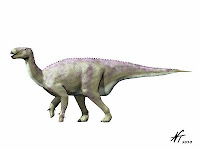
[from July 20, 2011]: 


Belgium
Belgium on palaeocritti site (neglected listing all the others?):
- Iguanodon (Ornithopod, Lower Cretaceous [Apt], Bernissart)
- Ichthyosaurus communis (Ichthyopterygia IchthyosauriaThunnosauria)
Cetotherium
The modest sized Cetotherium was a primitive baleen whale that lived during the middle to late Miocene epoch (15 MYA) of the Neogene Period. This whale genus is known from several individual species, perhaps as many as 10, that have been found in the USA, across Europe and Russia. When compared with their modern counter parts (e.g. humpback whales), their sizes were much smaller 2-4 metres.
- I
- Name
- Cetotherium rathkii
- Authority
- Brandt, 1843
- Meaning of generic name
- 'Whale Beast'
- Age and Distribution
- Horizon: Middle Miocene (Serravallian).
Locality: Taman peninsula, Russia. - Classification
- Mammalia Cetacea Mysticeti Cetotheriidae.
- Further Reading
- J. F. Brandt. 1843. De cetotherio, novo balaenarum familiae genre in Rossia Meridionali ante aliquot annos effoso. Bulletin de La Classe Physico-Mathématique de L'Académie Impérial des Sciences de Saint Pétersberg 1(10-12):145-148.
- Synonyms
- Cetotherium rathkei
- II
- Name
- Cetotherium priscum
- Authority
- (Eichwald, 1840)
- Meaning of specific name
- Early
- Age and Distribution
- Horizon: Upper Middle Miocene (Sarmatian, Serravallian).
Locality: Kertsch, Ukraine.
Also: Austria (Szentmargita, Leitha Limestone Formation, Langhian); Moldova (Chisinau, Serravalian); Romania (Madulari, Serravalian); Russia (Kutsay Mountain, Serravallian); Turkey (Kurtchu-Tchekmedje, Up. Miocene). - Classification
- Mammalia Cetacea Mysticeti Cetotheriidae.
- Further Reading
- C. E. Eichwald. 1840. Bescrieibung einiger Knocken des Ziphius priscus. Die Urwelt Russlands 2:25-53.
- Synonyms
- Choneziphius priscus, Plesiocetus priscus, Ziphius priscus
- III
- Name
- Cetotherium pusillum
- Authority
- Nordmann, 1860
- Meaning of specific name
- weeny small
- Age and Distribution
- Horizon: Middle Miocene (Serravallian).
Locality: Chisinau, Moldova. - Classification
- Mammalia Cetacea Mysticeti Cetotheriidae.
- Further Reading
- A. Nordmann. 1860. Palaentologie Sudresslands 1-360.
- IV
- Name
- Cetotherium ambiguum
- Authority
- Brandt, 1873
- Meaning of specific name
- ambiguous
- Age and Distribution
- Horizon: Late Middle Miocene (Sarmatian, Serravallian).
Locality: Nussdorf, Austria. - Further Reading
- J. F. Brandt. 1873. Untersuchungen über die fossilen und subfossilen cetaceen Europa's. Mémoires de L'Académie Impériale des Sciences de Saint-Petersbourg, Series 7 20(1):1-372.
- V
- Name
- Cetotherium crassangulum
- Authority
- Cope, 1895
- Meaning of specific name
- of thick angles
- Remains
- Holotype (USNM 8517): a skull
- Age and Distribution
- Horizon: Yorktown Formation. Pliocene.
Locality: City Point, Virginia. - Further Reading
- E. D. Cope. 1895. Fourth contribution to the marine fauna of the Miocene period of the United States. Proceedings of the American Philosphical Society 34:135-155.
- VI
- Name
- Cetotherium furlongi
- Authority
- Kellogg, 1925
- Meaning of specific name
- "of a furlong" [not likely unless exaggeration] or "of Furlong" [whoever that was]
- Remains
- Holotype (USNM 26521): partial skeleton
- Age and Distribution
- Horizon: Vaqueros Formation. Early Miocene (Burdigalian).
Locality: Stone Canyon, California. - Further Reading
- R. Kellogg. 1925. Fossil cetotheres from California. Contributions to Palaeontology from the Carnegie Institution of Washington (2)35-56 .
- Image by Nobu Tamura (click to enlarge)
"Cetotherium furlongi" (but I think it is a whale): 
- VII
- Name
- Cetotherium klinderi
- Authority
- Brandt, 1871
- Meaning of specific name
- Age and Distribution
- Horizon: Late Middle Miocene (Sarmatian, Serravallian).
Locality: Mykolayiv, Ukraine. - Further Reading
- J. F. Brandt. 1871. Bericht uber den Fortgang meiner Studien uber di Cetaceen, welche das grosse zur Tertiarzeit von Mitteleuropa bis Centralasien hinein ausgedehnte Meeresbechen bevolkerten. Bulletin de l'Academie Imperiale de St. Petersbourg 1871:563-566 .
[In proper German the words would read: Bericht über den Fortgang meiner Studien über die Cetaceen, welche das große zur Tertiarzeit von Mitteleuropa bis Centralasien hinein ausgedehnte Meeresbecken bevölkerten. Perhaps the printer in St. Petersbourg was short of German letter types?] - VIII
- Name
- Cetotherium maicopicum
- Authority
- Spasski, 1951
- Meaning of specific name
- from Maikop
- Remains
- Holotype (IBP S144, S131, S142, S154, S125, S126, S128, S130):partial skeleton
- Age and Distribution
- Horizon: Late Middle Miocene (Sarmatian, Serravallian).
Locality: River Belaia, Russia. - Further Reading
- P. I. Spasski. 1951. Ostaki tsetoheriev iz Servernogo Kavkaza (okr. g. Maikopa) [Remains of cetotheria from the Northern Caucasus in the neighborhood of Maikop Town.] Izvestia Akademii Nauk Azerbaidzhanskoi SSR 2:57-65.
- IX
- Name
- Cetotherium mayeri
- Authority
- Brandt, 1871
- Age and Distribution
- Horizon: Late Middle Miocene (Sarmatian, Serravallian).
Locality: Russia (River Belaia, Derbent, Kuban) and Georgia. - Further Reading
- J. F. Brandt. 1871. Bericht uber den Fortgang meiner Studien uber di Cetaceen, welche das grosse zur Tertiarzeit von Mitteleuropa bis Centralasien hinein ausgedehnte Meeresbechen bevolkerten. Bulletin de l'Academie Imperiale de St. Petersbourg 1871:563-566 . [For correct linguistic form of title, see above]
A. N. Riabinin. 1934. New contributions to the osteology of Cetotherium mayeri Brandt, from the Upper Sarmatian of the North Caucasus. Transactions of the United Geological and Prospecting Service of USSR 350:1-15. - X
- Name
- Cetotherium parvum
- Authority
- Trouessart, 1898
- Meaning of specific name
- small
- Age and Distribution
- Horizon: Saint Marys Formation. Late Miocene (Tortonian).
Locality: Drum Point, Calvert County, Maryland, US.
Also: Charles County, Maryland, US (Calvert Formation, Serravallian) - Further Reading
- E. L. Trouessart. 1898. Catalogus mammalium tam viventium quam fossilum 5:665-1264.
- Synonyms
- Cetotherium pusillum Cope 1868, Delphinapterus tyrannus Cope 1868
- I- X, Creationist comment:
- What if they are just plain old whales?

Sunday, 8 December 2013
Austria
Austria on palaeocritti site:
- Unlisted
- Gosau Formation, Austria, Upper Cretaceous (Campanian)
- Doratodon carcharidens (Crocodylomorpha)
- Mochlodon suessi (Ornithopoda Iguanodontia Rhabdodontidae)
- Linzer Sanden Formation, Upper Oligocene (Chattian)
- Cetotheriopsis lintianus (Mammalia Cetacea Mysticeti Cetotheriopsidae)
- Leitha Limestone Formation, Middle Miocene (Serravallian)
- Cetotherium priscum (Mammalia Cetacea Mysticeti Cetotheriidae)
- Heterodelphis leiodontus (Mammalia Cetacea Odontoceti)
- Nußdorf, Late Middle Miocene (Sarmatian, Serravallian)
[Nussdorf/Nußdorf, wine village just outside Vienna]
- Praepusa vindobonensis (Mammalia Carnivora Phocidae)
- Cetotherium ambiguum (Mammalia Cetacea Mysticeti Cetotheriidae)
- Kentriodon fuchsii (Mammalia Cetacea Odontoceti Kentriodontidae)
- Pachyacanthus suessii (Mammalia Cetacea)
- Pachyacanthus letochae (Mammalia Cetacea)
Cetotheriopsis lintianus
Like many early discoveries, the fossil of Cetotheriopsis lintianus (a partial skull) discovered from the Late Oligocene of Austria, has a complex nomenclatural history. It has been described at least twice, first by von Meyer as Balaeonodon lintianus and as Stenodon lentianus by Van Beneden, 1865. Brandt assigned the first to Cetotheriopsis in 1871 and van Beneden, the second to Aulocetus in 1875. The name Cetotheriopsis has been retained making Aulocetus a junior synonym but Aulocetus becomes problematic as several species not related to Cetotheriopsis have also been placed in this genus.
- Name
- Cetotheriopsis lintianus
- Authority
- (von Meyer, 1849)
- Meaning of generic name
- Whale beast face
[wow, actually composed of three words!] - Meaning of specific name
- From Linz
- Remains
- Holotype (OL 1999/27): partial skull.
- Age and Distribution
- Horizon: Linzer Sanden Formation. Late Oligocene (Chattian).
Locality: Near Linz, Austria. - Classification
- Mammalia Cetacea Mysticeti Cetotheriopsidae
- Further Reading
- H. Meyer. 1849. [Letter on various fossils]. Neues Jahrbuch fur Mineralogie, Geognosie, Geologie un Petrefakten-Kunde 1849:547-550.
J. F. Brandt. 1871. Bericht uber den Fortgang meiner Studien uber di Cetaceen, welche das grosse zur Tertiarzeit von Mitteleuropa bis Centralasien hinein ausgedehnte Meeresbechen bevolkerten. Bulletin de l'Academie Imperiale de St. Petersbourg 1871:563-566
K. Rothausen. 1971. Cetotheriopsis tobieni n. sp., der este paläogene Bartenwal (Cetotheriidae, Mysticeti, Mamm.) nördlich des Tethysraumes. Abhandlungen des Hessischen Landesamtes fuer Bodenforschung 60:131-148. - Synonyms
- Aulocetus lentianus (van Beneden, 1865), Balaenodon lintianus von Meyer, 1849, Balaenodon linzianus (Brandt, 1871), Cetotheriopsis linziana Brandt, 1871, Stenodon lentianus Van Beneden, 1865
Subscribe to:
Posts (Atom)