- Name
- Uberabatitan ribeiroi
- Authority
- Salgado & Carvalho, 2008
- Meaning of generic name
- After the city of Uberaba, located near the type locality of the type specimen of the type species, and the suffix titan, giant in Greek mythology
- Meaning of specific name
- In honor of Luiz Carlos Borges Ribeiro.
[correct genitive: riberi or ribeiri] - Size
- [not given]
- Remains
- Holotype: Specimen A (CPP-UrHo): CPP-1058-UrHo, 1057- UrHo, 914-UrHo, 919-UrHo (anterior cervical vertebrae); 1091- UrHo, 1104-UrHo (anterior cervical neural arches); 992-UrHo, 1023-UrHo (mid-cervical vertebrae); 993-UrHo, 915-UrHo (posterior cervical centra); 922-UrHo, 917-UrHo, 1081-UrHo, 921- UrHo, 929-UrHo, 1105-UrHo (cervical ribs); 1077-UrHo (anterior dorsal); 1068-UrHo (mid-dorsal neural arch); 923-UrHo (dorsal rib); 1099-UrHo (sacral centrum); 1079-UrHo (anterior caudal vertebra); 1017-UrHo (mid-caudal vertebra); 1009-UrHo, 1010-UrHo, 1011-UrHo, 1012-UrHo (posterior caudal vertebrae); 1056-UrHo (anterior haemal arch); 1006-UrHo (posterior haemal arch); 1027-UrHo (sternal plate); 1109-UrHo (right coracoid); 1030-UrHo (left humerus); 1032-UrHo (left radius); 911-UrHo (right radius); 1080-UrHo (right metacarpal); 1029- UrHo, 1103-UrHo (left and right pubes); 912-UrHo (left tibia); 1107-UrHo (left fibula); 1082-UrHo (left astragalus).
Referred Material: Specimen B (CPP-UrB): CPP-1075-UrB, 1022-UrB (anterior cervical vertebrae); 1085-UrB (anterior ⁄ mid-cervical vertebra); 994-UrB (mid-cervical vertebra); 1070-UrB (mid-cervical centrum); 1024-UrB, 1108-UrB (posterior cervical vertebrae); 918-UrB (cervical vertebra); 991-UrB (posterior cervical neural arch); 1014-UrB (posterior caudal vertebra); 1078-UrB (fragment of vertebra); 1065-UrB (dorsal rib); 1018-UrB (mid-caudal vertebra); 1019-UrB (mid-caudal vertebra); 1020-UrB (two fused mid-caudal vertebrae); 1008-UrB (posterior caudal centrum); 1005-UrB, 1003-UrB, 1004-UrB (haemal arches); 1120-UrB (left coracoid); 913-UrB (fragment of right pubis); 1026-UrB (fragment of ischium), 898-UrB (distal end of a right femur); 1106-UrB (left fibula). Specimen C (CPP-UrC): CPP-1116-UrC (mid-dorsal centrum); 894-UrC (partial right femur). - Remains version β
- Specimen A: 3 anterior cervical vertebrae; 2 anterior cervical neural arches; 2 mid-cervical vertebrae; 2 posterior cervical centra; 6 cervical ribs; 1 anterior dorsal; 1 mid-dorsal neural arch; 1 dorsal rib; 1 sacral centrum; 1 anterior caudal vertebra; 1 mid-caudal vertebra; 4 posterior caudal vertebrae; 1 anterior haemal arch; 1 posterior haemal arch; 1 sternal plat); 1 right coracoid; left humerus; left & right radii; 1 right metacarpal; left and right pubes; left tibia and fibula); 1 left astragalus.
- Specimen B: 2 anterior cervical vertebrae; 1 anterior ⁄ mid-cervical vertebra; 1 clearly mid-cervical vertebra; 1 mid-cervical centrum; 2 posterior cervical vertebrae; 1 cervical vertebra; 1 posterior cervical neural arch; 1 posterior caudal vertebra; 1 fragment of vertebra; 1 dorsal rib; 2 mid-caudal vertebrae non fused; two fused mid-caudal vertebrae; 1 posterior caudal centrum; 3 haemal arches; 1 left coracoid; 1 fragment of right pubis; 1 fragment of ischium, distal end of a right femur; left fibula.
- Specimen C : 1 mid-dorsal centrum; partial right femur.
- Version γ
- Three extremely incomplete skeleta, and extremely disarticulate, none of which has a skull, two of which seem to have had a tail.
- Age and Distribution
- Horizon: Marilia Formation. Upper Cretaceous (Maastrichtian)
Locality: Uberaba, Minas Gerais state, Brazil. - Classification
- Saurischia Sauropodomorpha Sauropoda Macronaria Titanosauriformes Titanosauria
- Further Reading
- L. Salgado and I. d. S. Carvalho. 2008. Uberabatitan ribeiroi, a new titanosaur from the Marília Formation (Bauru Group, Upper Cretaceous), Minas Gerais, Brazil. Palaeontology 51(4):881-901.
- Creationist comment:
- So little is given in holotype, sorry, in specimen C, I am not sure it can be excluded it was a real "titan" or "human shaped but gigantic mighty one" of the nephelim.
But I am not an anatomist or palaeontologist. I am not one of the medicine students of my family.
The other two specimens have bones identified as caudals, i e tail bones.
Showing posts with label Brazil. Show all posts
Showing posts with label Brazil. Show all posts
Tuesday, 3 December 2013
Uberabatitan ribeiroi

Gondwanatitan faustoi
- Name
- Gondwanatitan faustoi
- Authority
- Kellner & Azevedo, 1999
- Meaning of generic name
- "Gondwana titan".
- Meaning of specific name
- In honor of Dr. Fausto L. de Souza Cunha, who collected the specimen.
[Fausto = Faustus, the correct genitive is Fausti and neither **Faustusi nor **Faustoi] - Size
- [not given]
- Remains
- Holotype (MN 4111-V): Partial skeleton composed of 2 partial cervicals, 7 dorsals, 6 sacrals, 24 caudals, 4 unidentified vertebrae, proximal part of left scapula, left ilium, partial pubs, ischia, humeri, tibiae, ribs and several unidentified fragments.
- Age and Distribution
- Horizon: Adamantina formation. Bauru Group. Upper Cretaceous (Turonian-Santonian)
Locality: São Paolo State, Brazil. - Classification
- Saurischia Sauropodomorpha Sauropoda Macronaria Titanosauriformes Titanosauria Saltasauridae Aelosaurini
- Further Reading
- A. W. A. Kellner and S. A. K. d. Azevedo. 1999. A new sauropod dinosaur (Titanosauria) from the Late Cretaceous of Brazil. In Y. Tomida, T. H. Rich, and P. Vickers-Rich (eds.), Proceedings of the Second Gondwanan Dinosaur Symposium, National Science Museum Monographs 15:111-142.
- Synonyms
- Aeolosaurus faustoi (Kellner & Azevedo, 1999)
Maxakalisaurus topai
This titanosaur was closely related to the Argentinian Saltasaurus and its body was protected with osteoderms. This is the largest known dinosaur of Brazil.
- Name
- Maxakalisaurus topai
- Authority
- Kellner, Campos, Azevedo, Trotta, henriques, Craik and Silva, 2006
- Meaning of generic name
- The generic name is formed by Maxakali, from one of the Macro-jê stock language, honoring the Maxakali ethnic group that is present in the Minas Gerais State where this dinosaur was found, and saurus, which is the Greek word for lizard.
- Meaning of specific name
- From Topa, one of the Maxacali deities.
[Idolatrous, should have been Topae rather than Topai] - Size
- Body length: 13 m ; Skull length: [not given]
- Remains
- Holotype (MN 5013-V): Partial skeleton composed of an incomplete right maxilla (with teeth), the remains of 12 cervical vertebrae (including several cervical ribs), part of seven dorsals (and ribs), one sacral neural spine, one sacral centrum, six caudals, several hemal arches, part of both scapulae, both sternal plates, the distal portion of a left ischium, both humeri, the second and forth right metacarpals, incomplete fibula, one osteoderm, and several unidentified bones.
- Age and Distribution
- Horizon: Adamantina Formation. Bauru Group. Upper Cretaceous (Turonian-Santonian)
Locality: Minas Gerais, Brazil. - Classification
- Saurischia Sauropodomorpha Sauropoda Macronaria Titanosauriformes Titanosauria Titanosauridae Saltasaurinae
- Further Reading
- A. W. A. Kellner, D. d. A. Campos, S. A. K. Azevedo, M. N. F. Trotta, D. D. R. Henriques, M. M. T. Craik, and H. P. Silva. 2006. On a new titanosaur sauropod from the Bauru Group, Late Cretaceous of Brazil. Boletim do Museu Nacional, Nova Série, Geologia 74:1-31.
- Creationist comment
- Re "its body was protected with osteoderms", according to holotype those have not been found. The osteoderms of Saltasaurus have however been found and Maxakalisaurus is deemed "a close relative".
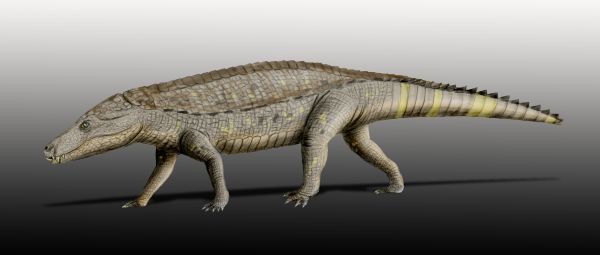
Armadillosuchus arrudai
This bizarre crocodylomorph from the Late Cretaceous of Brazil was protected by a heavy body armor akin to the armadillo and showed adaptation for a fossorial life. It belongs to the the family Sphagesauridae, a group of highly specialized crocodile relatives from the Late cretaceous of Brazil.
- Name
- Armadillosuchus arrudai
- Authority
- Marinho & Carvalho, 2009
- Meaning of generic name
- "Armadillo crocodile".
- Meaning of specific name
- In honor of João Tadeu Arruda.
[Simplest latinisation of Arruda is - Arruda. Its genetive is not Arrudai (except very early on, before Classic Latin) but Arrudae] - Size
- Skull length: , Length: [neither given]
- Remains
- Holotype (UFRJ DG 303-R): Nearly complete skull and postcranial elements (vertebrae, ribs, partial forelimb, osteoderms)
Referred materials: MPMA-64-0001-04 (partial skull). - Age and Distribution
- Horizon: Adamantina Formation, Bauru Basin. Late Cretaceous (Turonian-Santonian).
Locality: General Salgado County, São Paulo State, Brazil. - Classification
- Archosauromorpha Crurotarsi Paracrocodylomorpha Notosuchia Sphagesauridae
- Further Reading
- T. S. Marinho and I. d. S. Carvalho. 2009. An armadillo-like sphagesaurid crocodyliform from the Late Cretaceous of Brazil. Journal of South American Earth Sciences 27(1):36-4.
- Image by Nobu Tamura (click to enlarge)
Armadillosuchus arrudai: 
Oxalaia quilombensis
Oxalaia is the first formally described dinosaur species from the Cenomanian of Brazil.
- Name
- Oxalaia quilombensis
- Authority
- Kellner, Azevedeo, Machado, Carvalho and Henriques , 2011
- Meaning of generic name
- The generic name comes from Oxalá, the most respected masculine deity in the African pantheon, introduced in Brazil during slavery.
[Sounds idolatrous to me ...] - Meaning of specific name
- From the Portuguese expression quilombo, the place where the quilombola (the descendants of former Brazilian slaves) live. The Cajual Island, where the specimens of this new taxon were collected, is one of these places.
- Size
- Body length: 46 ft (14 m) ?
- Remains
- Holotype: MN 6117-V - a fused premaxillae.
Referred material MN 6119-V, an incomplete left maxilla. The specimen is held in the Museu Nacional/Universidade Federal do Rio de Janeiro, Brazil. - Age and Distribution
- Horizon: Alcantara Formation, Itapecuru, Group of the Sao Luís Basin, Cenomanian (early Late Cretaceous Period)
Locality: Laje do Coringa at the Cajual Island, Maranhao State (Corrêa-Martins1997), Northeast Brazil. Bone Bed. - Classification
- Dinosauria Saurischia Theropoda Spinosauroidea Spinosauridae
- Further Reading
- Kellner, Alexander W.A.; Sergio A.K. Azevedeo, Elaine B. Machado, Luciana B. Carvalho and Deise D.R. Henriques (2011). "A new dinosaur (Theropoda, Spinosauridae) from the Cretaceous (Cenomanian) Alcântara Formation, Cajual Island, Brazil". Anais da Academia Brasileira de Ciências 83 (1): 99–108. Original description.
- Image by Nobu Tamura (click to enlarge)
Oxalaia quilombensis: 

Santanaraptor placidus
- Name
- Santanaraptor placidus
- Authority
- Kellner, 1999
- Meaning of generic name
- ''Santana Thief" Named after the area of discovery
- Meaning of specific name
- Named in honour of Placido Cidade Nuvens
- Size
- Length: 4.1 ft (1.25 m)
- Remains
- Holotype (MN 4802-V) 3 caudal vertebrae with chevrons, ischia, femora, tibia, fibula, pes, and soft tissue.
- Age and Distribution
- Horizon: Santana Formation (Romualdo member), Lower Cretaceous (Albian)
Locality: Formacao Santana in the Chapada do Araripe region of the northeastern state of Ceara, Brazil - Classification
- Dinosauria Saurischia Theropoda Coelurosauria
- Further Reading
- Kellner, A. W. A. (1999). "Short Note on a new dinosaur (Theropoda, Coelurosauria) from the Santana Formation (Romualdo Member, Albian), northeastern Brazil". Boletim do Museu Nacional (Serie Geologia) 49: 1–8.
Guaibasaurus candelariensis
Guaibasaurus candelariensis was a dinosaur that lived during the Late Triassic (Norian) Period. A saurischian of some sort, apparently more primitive than Herrerasaurus and Staurikosaurus. Remains of Guaibasaurus were discovered in Rio Grande do Sul, Brazil. Two partially complete specimens have been attributed to Guaibasaurus, the first was described in 1999 both specimens lacked the discovery of a skull. Guaibasaurus had three full fingers and two vestigial ones on each hand, like Herrerasaurus. This animal may have grown to lengths of around 6.6 feet (2 metres). The reconstruction of the head is hypothetical as no skull has been found.
- Name
- Guaibasaurus candelariensis
- Authority
- Bonaparte, Ferigolo and Ribeiro,1999
- Meaning of generic name
- Guaiba lizard
[ok, but where or what is Guaiba? Guaíba is a city in Rio Grande do Sul] - Size
- Length: 1.8 m
- Remains
- Holotype (MCN-PV 2355): partial skeleton
- Age and Distribution
- Caturrita Formation (Norian), Rio Grande do Sul, Brazil
- Classification
- Dinosauria Saurischia
- Further Reading
- J. F. Bonaparte, J. Ferigolo, and A. M. Ribeiro. 1999. A new early Late Triassic saurischian dinosaur from Rio Grande do Sol state, Brazil. Y. Tomida, T. H. Rich, & P. Vickers-Rich (eds.), Proceedings of the Second Gondwanan Dinosaur Symposium, National Science Museum Monographs 15:89-109
- Image by Nobu Tamura (click to enlarge)
Guaibasaurus candelariensis: 

Unaysaurus tolentinoi
Unaysaurus is the first prosauropod dinosaur discovered in Brazil. The holotype (4FSM 11069) of Unaysaurus was found in the Caturrita Formation in Brazil. It was unearthed in Carnian-Norian strata and dates to around 225 million years ago. Unaysaurus had a length of about 2.5 m. (8.2 feet). Its height was 70-80 cm.. (2-3 feet). This dinosaur shows affinities to Plateosaurus and may belong in the family Plateosauridae.
- Name
- Unaysaurus tolentinoi
- Authority
- Leal, Azevodo, Kellner and da Rosa, 2004.
- Meaning of generic name
- "Black Water" in the local Tupi language
- Meaning of specific name
- Named after Tolentino Marafiga, who discovered the fossils by the side of a road in 1998
[actually his name would be Tolentinus in most simple latinization, so the generic name should have been Tolentini] - Size
- Body Length: 8.2 ft (2.5 m)
- Remains
- Holotype 4FSM 11069: a partial (semi articulated) skeleton with almost complete skull and lower jaw.
- Age and Distribution
- Horizon: Caturrita Formation, Late Triassic Period (Carnian - Norian)
Locality: Rio Grande do Sul, near the city of Santa Maria, Southern Brazil - Classification
- Dinosauria Saurischia Sauropodamorpha Prosauropoda ?Plateosauridae
- Further Reading
- Luciano A. Leal, Sergio A. K. Azevodo, Alexander W. A. Kellner, and Átila A. S. da Rosa. 2004. "A new early dinosaur (Sauropodomorpha) from the Caturrita Formation (Late Triassic), Paraná Basin, Brazil". Zootaxa 690: 1–24.
Staurikosaurus pricei
- Name
- Staurikosaurus pricei
- Authority
- Colbert, 1970
- Meaning of generic name
- Southern cross lizard
[Southern Cross is actually not "staurikos" or "staurikon" but "Σταυρός του Νότου" or "Νότιος Σταυρός" in Greek] - Meaning of specific name
- [of Price]
- Size
- Length: 2 m
- Remains
- Holotype (MCZ 1669): partial skeleton
- Age and Distribution
- Santa Maria Formation (Carnian), Rio Grande do Sul, Brazil
- Classification
- Dinosauria Saurischia Herrerasauria Staurikosauridae
- Further Reading
- E. H. Colbert. 1970. A saurischian dinosaur from the Triassic of Brazil. American Museum Novitates 2405:1-39
- Image by Nobu Tamura (click to enlarge)
Staurikosaurus pricei: 

Saturnalia tupiniquim
This early and small dinosaur is considered to be a basalmost sauropodomorph. It is known from three partial skeletons from the Upper Triassic Santa Maria Formation of Brazil. A study by Brea et al. (2005) however shows close ressemblance with the basal theropod Guaibasaurus and regroup both genus in the family Guaibasauridae.
- Name
- Saturnalia tupiniquim
- Authority
- Langer, Abdala, Richter & Benton, 1999
- Meaning of generic name
- Saturnalia, Latin equivalent to carnival, in reference to the feasting period when the paratypes were found.
- Meaning of specific name
- tupiniquim, Portuguese word of indigenous Guarani origin, an endearing way of referring to native things from Brazil.
- Size
- Length: 1.5 m, Skull length: [not give]
- Remains
- Holotype (MCP 3844-PV): well-preserved semi-articulated skeleton.
Referred specimens: MCP 3845-PV (partial skeleton), MCP 3846-PV (partial skeleton) - Age and Distribution
- Horizon: Santa Maria Formation (=Caturrita Formation), Rhynchosaur zone, Upper Triassic (Late Carnian).
Locality: Santa Maria, Rio Grande do Sul, Brazil. - Classification
- Dinosauria Saurischia Sauropodomorpha?
- Further Reading
- M. C. Langer, F. Abdala, M. Richter and M. J. Benton. 1999. A sauropodomorph dinosaur from the Upper Triassic (Carnian) of southern Brazil. Comptes Rendus de l'Academie des Sciences, Paris: Sciences de la terre et des planètes 329:511-517.
M. C. Langer. 2003. The pelvic and hind limb anatomy of the stem-sauropodomorph Saturnalia tupiniquim (Late Triassic, Brazil). PaleoBios 23(2):1-40.
M. C. Langer. 2005. Saturnalia tupiniquim and the origin of sauropodomorphs. Journal of Vertebrate Paleontology 25(3, suppl.):82A.
G. Brea, J. F. Bonaparte, C. L. Schultz and A. G. Martinelli. 2005. A new specimen of Guaibasaurus candelariensis (basal Saurischia) from the Late Triassic Caturrita Formation of southern Brazil. In A. W. A. Kellner, D. D. R. Henriques, and T. Rodrigues (eds.), II Congresso Latino-Americano de Paleontologia de Vertebrados, Boletim de Resumos. Museum Nacional/UFRJ, Rio de Janeiro 55-56
Amazonsaurus maranhensis
Amazonsaurus was a Sauropod from the Early Cretaceous of Brazil. It is known from a fragmentary skeleton that does not allow to classify it with certainty beyond the diplodocoid.
- Name
- Amazonsaurus maranhensis
- Authority
- Carvalho, Avilla, Salgado, 2003
- Meaning of generic name
- Amazon lizard.
- Meaning of specific name
- From the Brazilian state of Maranhão.
- Size
- Length: 12 m, Skull length: [not given]
- Remains
- Holotype: MN 4558-V (dorsal neural spine), UFRJ-DG 58-R/9 (dorsal neural spine), MN 4559-V (dorsal centrum), MN s/n-V (dorsal centrum), neural spine of anterior caudal vertebra (UFRJ-DG 58-R/7), one mid caudal vertebra (MN 4555-V), one mid-posterior caudal vertebra (MN 4560-V), one posterior caudal vertebra (MN 4556-V), one posterior caudal vertebra (UFRJ-DG 58-R/10), four cehvrons (UFRJ-DG 58-R/2 through [...] 58-R/5), four more chevrons (MN 4564-V), ilium (UFRJ0-DG 58-R/1), partial pubis (MN s/n-V), and three ribs (MN 4562-V)..
- Age and Distribution
- Horizon: Itapecuru Formation, Lower Cretaceous (Aptian–Albian).
Locality: Mata, Itapecuru-Mirim County, Maranhão State, Brazil. - Classification
- Dinosauria Saurischia Sauropodomorpha Sauropoda Diplodocoidea
- Further Reading
- I. d. S. Carvalho, L. d. S. Avilla, and L. Salgado. 2003. Amazonsaurus maranhensis gen. et sp. nov. (Sauropoda, Diplodocoidea) from the Lower Cretaceous (Aptian-Albian) of Brazil. Cretaceous Research 24:697-713.
Tapuiasaurus macedoi
Tapuiasaurus is the 17th Brazilian dinosaur described and the 9th titanosaur. The specimen bears a wonderfully preserved skull. Like most titanosaurs Tapuiasaurus possessed a large array of osteoderms along its back.
- Name
- Tapuiasaurus macedoi
- Authority
- Zaher & Carvalho, 2010
- Meaning of generic name
- Named after the tribe 'Tapuia' in the territory near where the specimen was found
- Size
- Body length: 13 m
- Remains
- Holotype: partial skeleton with a near complete skull
- Age and Distribution
- Horizon: Lower Cretaceous (Aptian)
Locality: Minas Gerais, Eastern Brazil - Classification
- Dinosauria Saurischia Sauropodomorpha Titanosauria
- Further Reading
- Zaher & Carvalho, 2010 PLoS (In press)
- Image by Nobu Tamura (click to enlarge)
Tapuiasaurus macedoi: 

Friday, 29 November 2013
Tupuxuara
Tupuxuara is a crested and toothless genus of pterosaur from the Early Cretaceous of Brazil. Three species have been recognized, all from the same Santana Formation: T. longicristatus, T. leonardii and T. deliradamus. Females and males have slightly different crest indicating sexual dimorphism and is a mark of adulthood as juveniles are crestless (Martill & Naish, 2006). Tupuxuara, judging by the wing wing proportions and the general environment where it lived, as well as the lack of any adaptations to piscivory, was most likely a terrestrial generalist, much like other azhdarchids and modern secretary birds and seriemas.
- I
- Name
- Tupuxuara longicristatus
- Authority
- Kellner & Campos, 1988
- Meaning of generic name
- "Familiar spirit" — A name in Tupi Indian mythology
[or perhaps rather magic] - Meaning of specific name
- long crested
- Size
- [not given]
- Remains
- Partial skeleton.
- Age and Distribution
- Romualdo Member, Santana Formation (Early Cretaceous, Albian) Ceará, Brazil.
- Classification
- Pterosauria Pterodactyloidea Azhdarchoidea
- Further Reading
- Kellner, A. W. A. & Campos, D. A. 1988, Sobre un novo pterossauro com crista sagital da Bacia do Araripe, Cretaceo Inferior do Nordeste do Brasil. (Pterosauria, Tupuxuara, Cretaceo, Brasil) Anais de Academia Brasileira de Ciências, 60, 459–469.
- II
- Name
- Tupuxuara leonardii
- Authority
- Kellner & Campos, 1994
- Meaning of specific name
- (in honour of) Leonardi
- Size
- Skull length: 900 mm, Wingspan: 4.5 m
- Remains
- Partial skeletons including a complete skull.
- Age and Distribution
- Romualdo Member, Santana Formation (Early Cretaceous, Albian) Ceará, Brazil.
- Classification
- Pterosauria Pterodactyloidea Azhdarchoidea
- Further Reading
- Kellner, A. W. A. & Campos, D. A. 1994, A new species of Tupuxuara (Pterosauria, Tapejaridae) from the Early Cretaceous of Brazil. An. Acad. Brasil. Ciênc. 66, 467–473.
- III
- Name
- Tupuxuara deliradamus
- Authority
- Witton, 2009
- Size
- Skull length: 850 mm
- Remains
- Two partial skulls.
- Age and Distribution
- Romualdo Member, Santana Formation (Early Cretaceous, Albian) Ceará, Brazil.
- Classification
- Pterosauria Pterodactyloidea Azhdarchoidea
- Further Reading
- Witton, M.P. 2009. A new species of Tupuxuara (Thalassodromidae, Azhdarchoidea) from the Lower Cretaceous Santana Formation of Brazil, with a note on the nomenclature of Thalassodromidae. Cretaceous Research.
- I - III ?
- Further reference:
- Martill, D. M. & Naish, D. 2006. Cranial crest development in the azhdarchoid pterosaur Tupuxuara, with a review of the genus and tapejarid monophyly. Palaeontology 49, 925-941.
Tupandactylus imperator
Tupandactylus from the Early Cretaceous of Brazil is characterized by its very large head crest made partly of bone and partly of soft tissue (keratin). It was originally described as a species of Tapejara.
- Name
- Tupandactylus imperator
- Authority
- (Campos & Kellner, 1997)
- Meaning of generic name
- Tupan (name of the Tupi thunder God) finger
["dactylus"="finger" stands for "pterodactylus"="wing finger" which is too long for an ending - the beginning of the word seems laden with idolatry!] - Meaning of specific name
- commander-in-chief or emperor (depending on what period of Latin)
- Size
- Skull length: 800 mm, Wingspan: ? 2.5 m
- Remains
- Nearly complete skull.
- Age and Distribution
- Crato Member, Santana Formation (Early Cretaceous, Aptian-Albian) Ceará, Brazil.
- Classification
- Pterosauria Pterodactyloidea Azhdarchoidea Tapejaridae
- Further Reading
- Campos, D. A. & Kellner, A. W. A. 1997, Short note on the first occurrence of Tapejaridae in the Crato Member (Aptian), Santana Formation, Araripe Basin, Northeast Brazil. An. Acad. Brasil. Ciênc., 69(1): 83-87.
Kellner, A.W.A. & Campos, D.A. 2007, Short note on the ingroup relationships of the Tapejaridae (Pterosauria, Pterodactyloidea. Boletim do Museu Nacional 75: 1–14. - Synonyms
- Tapejara imperator Campos & Kellner, 1997; Ingridia imperator (Campos & Kellner, 1997) Unwin & Martill, 2007
- Image by Nobu Tamura (click to enlarge)
Tupandactylus imperator: 

Thalassodromeus sethi
Thalassodromeus is a pterosaur from the Early Cretaceous of Brazil. It had an extraordinary large skull surmounted by a huge bony crest. The crest was irrigated by blood vessels and might have been used for body temperature regulation. The beak is similar in shape with the one of the modern skimmer (Rhynchops) and it was suggested that Thalassodromeus might have had a similar feeding strategy. However, new biomechanical studies of the neck show that its unlikely that it was a skimmer. The scizzor like jaws indicate it might had been a scavenger, or an aerial piscivore that used the jaws to grasp prey rather than skim.
- Name
- Thalassodromeus sethi
- Authority
- Kellner & Campos, 2002
- Meaning of generic name
- Sea runner
- Size
- Skull length: 1.4 m, Wingspan: 4.5 m
- Remains
- Nearly complete skull.
- Age and Distribution
- Romualdo Member, Santana Formation (Early Cretaceous, Aptian-Albian) Ceará, Brazil.
- Classification
- Pterosauria Pterodactyloidea Azhdarchoidea
- Further Reading
- Kellner A. W. A. and Campos D. A., 2002, The function of the cranial crest and jaws of a unique pterosaur from the early Cretaceous of Brazil. Science. vol. 297, no. 5580 19 July 2002, pp. 389-392.
Provelosaurus americanus
Originally described as a South American member of the genus Pareiasaurus, it was reassigned to the genus Provelosaurus by Lee in 1997 as it shows more affinities with the south African dwarf pareiasaurs (Anthodon, Nanoparia, Pumiliopareia) than with Pareiasaurus.
- Name
- Provelosaurus americanus
- Authority
- (Araújo, 1985)
- Size
- Length: 1-2 m
- Remains
- Nearly complete skull and postcranial elements of at least four individuals.
- Age and Distribution
- Upper Permian Rio do Rasto Formation, Paraná Basin, Rio Grande do Sula, Brazil.
- Classification
- Anapsida Hallucicrania Pareiasauria
- Further Reading
- Araujo, D. C. F., 1985, Sobre Pareiasaurus americanus sp. nov., do Permiano Superior do Rio Grande do Sul, Brasil. I-Diagnose Especifica: Annais Academia Brasil, Ciences, v. 57, n. 1, p. 63-66.
- Synonyms
- Pareiasaurus americanus Araújo, 1985
Thursday, 28 November 2013
Tapejara
Tapejara is a toothless crested pterosaur from the Early Cretaceous of Brazil. There were originally 3 species assigned to the genus, but today, only one species is recognized, T. wellnhoferi. The species T. imperator was transferred to the genus Tupandactylus, while the species T. navigans is waiting to receive a new generic name.
- I
- Name
- Tapejara wellnhoferi
- Authority
- Kellner, 1989
- Meaning of generic name
- "Ancient being" — A name in Tupi Indian mythology
- Size
- Skull length: 250 mm, Wingspan: 1.5 m
- Remains
- Several partial skeletons.
- Age and Distribution
- Romualdo Member, Santana Formation (Early Cretaceous, Aptian-Albian) Ceará, Brazil.
- Classification
- Pterosauria Pterodactyloidea Azhdarchoidea Tapejaridae
- Further Reading
- Kellner A. W. A. 1989, A new edentate pterosaur of the Lower Cretaceous from the Araripe Basin, Northeast Brazil, Anais de Academia Brasileira de Ciencias, 61:439-446.
Wellnhofer, P. & Kellner, A. W. A. 1991, The skull of Tapejara wellnhoferi Kellner (Reptilia: Pterosauria) from the Lower Cretaceous Santana Formation of the Araripe Basin, Northeastern Brazil. Mitt. bayer. Staatsslg Paläont. hist. Geol.31, 89–106. - II
- Name
- "Tapejara" navigans
- Authority
- Frey, Martill & Buchy, 2003
- Size
- Skull length: 240 mm, Wingspan: ?1.5 m
- Remains
- Complete skull.
- Age and Distribution
- Nova Olinda Member, Crato Formation (Early Cretaceous, Aptian) Ceará, Brazil.
- Classification
- Pterosauria Pterodactyloidea Azhdarchoidea
- Further Reading
- Frey, E., Martill, D., M., and Buchy, C. C., 2003, A new species of tapejarid pterosaur with soft tissue head crest: In: Evolution and Palaeobiology of Pterosaurs, edited by Buffetaut, E., and Mazin, J.-M., Geological Society Special Publication, n. 217, p. 65-72.
- Synonyms
- Ingridia navigans (Frey, Martill & Buchy, 2003) Unwin and Martill, 2007
- Images by Nobu Tamura (click to enlarge):
Tapejara wellnhoferi: 
"Tapejara" navigans/Tupandactylus navigans: 
- Confer also
- Tupandactylus imperator


Ornithocheirus
The name Ornithocheirus ("Bird hand") was coined by paleontologist Harry G. Seeley in 1869 to describe a number of pterosaurs fragmentary bones found in the Early Cretaceous Cambridge Greensand, England. He placed the different pieces up to 28 species of Ornithocheirus. Since then, the genus has become a terrible wastebasket taxon with over 40 species described from fragmentary fossils from the Early Cretaceous of Europe (England, France, Czech Republic) and South America (Brazil).
To add to the confusion, several species were transfered to a number of different genera including Criorhynchus, Coloborhynchus, Lonchodectes, Anhanghera and Tropeognathus. At the end, it is possible that none of the numerous species of Ornithocheirus is valid. A generic portrait of Ornithocheirus described it as a medium to large size pterosaur with a wingspan of 4 to meters. characterized by a long narrow and toothed jaws with a crest on top of the anterior portion of the snout.
To add to the confusion, several species were transfered to a number of different genera including Criorhynchus, Coloborhynchus, Lonchodectes, Anhanghera and Tropeognathus. At the end, it is possible that none of the numerous species of Ornithocheirus is valid. A generic portrait of Ornithocheirus described it as a medium to large size pterosaur with a wingspan of 4 to meters. characterized by a long narrow and toothed jaws with a crest on top of the anterior portion of the snout.
- Name
- Ornithocheirus simus, mesembrinus
- Authority
- simus (Seeley, 1869)
mesembrinus (Wellnhofer, 1987) - Meaning of generic name
- Bird Hand
- Size
- Wingspan: 2.5 m
- Remains
- Several jaw fragments, fragmentary skeletons and isolated bones and teeth.
- Age and Distribution
- Upper Cretaceous Greensand Formation (Cenomanian), Cambridge, England.
Upper Cretaceous Santana Formation (Cenomanian), Brazil. - Classification
- Pterosauria Pterodactyloidea Ornithocheiridae
- Further Reading
- Unwin, David M. (2006). The Pterosaurs: From Deep Time. New York: Pi Press. pp. 246.
- Image by Nobu Tamura (click to enlarge):
Ornithocheirus simus: 

Sacisaurus agudoensis
Based on a few fragmentary remains, Sacisaurus was apparently a smaller relative of the polish Silesaurus. This little beaked herbivore was a precursor of the ornithischian dinosaur.
- Name
- Sacisaurus agudoensis
- Authority
- Ferigolo and Langer, 2007
- Meaning of generic name
- Saci (a fabled entity of Brazilian lore that possesses a single leg) lizard
- Meaning of specific name
- From Agudo, the town where the material was found
- Size
- Length: 1.5 m
- Remains
- Holotype (MCN PV10041): Left dentary
Referred specimens: Dentaries, skull fragments, right scapula, partial hindlimb and sacrum, isolated vertebrae. - Age and Distribution
- Horizon: Caturrita Formation, Upper Triassic (latest Carnian-early Norian).
Locality: Aguda, Rio Grande del Sul, South Brazil - Classification
- Dinosauromorpha Dinosauriformes
- Further Reading
- J. Ferigolo and M. C. Langer. 2007. A Late Triassic dinosauriform from south Brazil and the origin of the ornithischian predentary bone. Historical Biology 19(1):23-33
- Image by Nobu Tamura (click to enlarge)
Sacisaurus agudoensis: 

Ludodactylus sibbicki
The specific name of this large pterosaur honors famous paleoartist John Sibbick. Ludodactylus was a crested ornithocheirid from the Early Cretaceous of Brazil, known from a single nearly complete skull missing the distal end of the crest. It was preserved with a leaf between its mandibles thus its nickname, the "tree-biter" and on the same slab that contain the fossils of the fish Dastilbe. The generic name refered to the fact that the animal resembles the inacurrate popular depiction of toy Pteranodon with teeth (Pteranodon was crested but toothless). It may turn out that Ludactylus is the same animal than Brasileodactylus.
- Name
- Ludodactylus sibbicki
- Authority
- Frey, Martill & Buchy, 2003
- Meaning of generic name
- Toy Finger
[When a name ends in "finger" / "dactylus" it usually is short for "wing finger" = "pterodactylus"] - Size
- Wingspan: 4 m, Skull length: 660 mm
- Remains
- Holotype (SMNK PAL 3828) : Nearly complete skull.
- Age and Distribution
- Crato Formation (Early Cretaceous, Aptian) Chapada do Araripe region, Ceará, Brazil.
- Classification
- Pterosauria Pterodactyloidea Ornithocheiroidea Ornithocheirididae
- Further Reading
- Frey E., Martill D. M. and Buchy C.-C., 2003, A new crested Ornithocheirid from the Lower Cretaceous of north-eastern Brazil and the unusual death of an unusual pterosaur: In: Evolution and Palaeobiology of Pterosaurs, edited by Buffetaut, E., and Mazin, J.-M., Geological Society Special Publication, n. 217, p. 55-63.
Subscribe to:
Comments (Atom)